
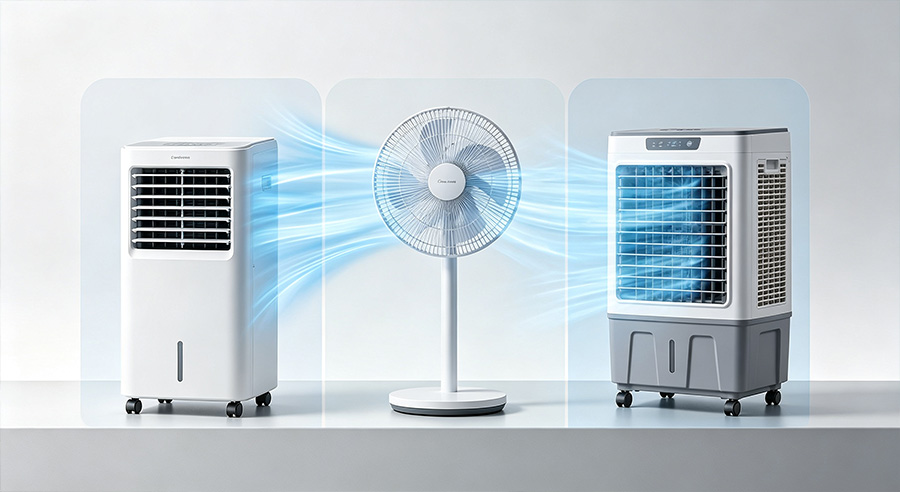
Portable AC vs. Fan vs. Evaporative Cooler: Which Cooling Solution Is Right for You?
First: How Each One Works
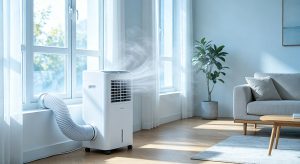
Uses a refrigerant cycle to physically remove heat and moisture from indoor air. The hot air and humidity are vented outside through an exhaust hose connected to a window or wall vent. It actively lowers the temperature of the room and dehumidifies at the same time.
Moves air around the room. It creates a wind-chill effect on your skin that helps sweat evaporate faster, making you feel cooler. It does not lower the actual air temperature in the room.
Blows warm air over water-saturated pads. The water evaporates, absorbing heat and cooling the air by 10–20 degrees. It adds moisture to the air while cooling it. No exhaust hose is needed, but it requires constant water refills and good ventilation.
Side-by-Side Comparison
1. Cooling Power
- Portable AC: Excellent. Actively lowers room temperature by 10–20°F, even on 95°F+ days. Works consistently regardless of outdoor conditions.
- Fan: Poor. Doesn’t cool the air at all. Only makes you feel cooler by moving air over your skin. Once the room is above 85–90°F, a fan just blows hot air around.
- Evaporative Cooler: Good in dry climates, useless in humid ones. Cools air by 10–20°F when humidity is below 40%. Cooling performance drops sharply above 50% humidity.
2. Energy Usage & Operating Cost
- Fan: Extremely low. A typical tower fan uses 30–60 watts, costing just a few cents per day to run.
- Evaporative Cooler: Low. Uses 100–300 watts, roughly 1/4 the power of a portable AC.
- Portable AC: Moderate. A 12,000 BTU unit uses 800–1200 watts, costing about $0.10–$0.15 per hour of operation. Efficient inverter models are on the lower end.
3. Upfront Purchase Cost
- Fan: $20–$150. Very affordable.
- Evaporative Cooler: $150–$400. Mid-range pricing.
- Portable AC: $250–$600+. Higher initial cost.
4. Installation & Portability
- Fan: Zero installation. Plug it in and use it instantly. Easy to move from room to room.
- Portable AC: Minimal installation. Requires setting up a window kit and exhaust hose. Takes 5–10 minutes. Wheels make it easy to move once the hose is disconnected. Premium models have no-screw, no-drill window kits that fit almost any window.
- Evaporative Cooler: Zero installation. Just fill the water tank and plug it in. Heavier than a fan but still movable.
5. Humidity Impact
- Fan: No effect on humidity.
- Portable AC: Removes humidity. Dehumidification is one of its biggest benefits—drier air feels cooler and more comfortable.
- Evaporative Cooler: Adds humidity. Great for dry climates, terrible for already-humid areas. Can make rooms feel clammy and promote mold if used in high humidity.
6. Noise Level
- Fan: Very quiet on low settings. No compressor noise.
- Evaporative Cooler: Moderate. Fan noise plus the sound of water trickling.
- Portable AC: Moderate. Has compressor and fan noise. Modern units are quiet on low/sleep mode (under 50 dB), comparable to a quiet office.
7. Best Use Cases
- Mild summer climates where temperatures only occasionally exceed 80°F
- Nights when you just need a breeze to sleep
- Supplementing an AC to spread cool air faster
- Budget cooling with almost no operating cost
- Dry, arid climates (Arizona, New Mexico, parts of Texas and California)
- Garages, workshops, and well-ventilated open spaces
- People who prefer natural cooling and don’t mind higher humidity
- Areas where electricity is very expensive
- Any climate, humid or dry
- Bedrooms, living rooms, and offices where consistent cool temperatures matter
- Renters who can’t install permanent AC
- Spaces that get hot even on mild days due to sun exposure
- Anyone who wants reliable, set-it-and-forget-it cooling
Common Scenarios: Which Should You Choose?
Scenario 1: You rent an apartment in a humid state like Florida or Texas.
Fans won’t be enough for 90°F+ humid days. Evaporative coolers will make the humidity worse. A portable AC with a simple window kit installs without damage, cools effectively, and removes sticky humidity.
Scenario 2: You live in Arizona, have a garage workshop, and hate high electric bills.
Dry desert heat is exactly what evaporative coolers thrive in. You’ll get strong cooling at a fraction of the AC cost, and the added humidity is actually a benefit in super-dry air.
Scenario 3: You already have central AC but your home office gets extra hot in the afternoon.
If central AC already cools the house mostly enough, a good desk or tower fan can handle the extra heat in one room without running a whole extra AC unit.
Scenario 4: You need cooling in your bedroom and you’re a light sleeper.
Look for a quiet inverter model with a dedicated sleep setting. It will run quietly all night, maintain a consistent temperature, and dehumidify so you don’t wake up sticky. A fan alone won’t cut it on hot nights.
Scenario 5: You’re on a very tight budget and summers are mild where you live.
If summer highs are mostly in the low 80s, a good fan combined with open windows at night can provide enough comfort for very little money.
Can You Combine Them for Better Results?
- Use a portable AC as your primary cooling source
- Add a small fan near your seating area or bed for extra personal cooling
- Run the portable AC on dehumidifier mode on mild, humid days
- Use natural ventilation at night to pre-cool the house




Add comment