
The Complete Guide to Cooling Small Apartments: Maximize Comfort in Minimal Space
Small apartments have unique cooling challenges. Limited square footage, lots of sunlight from large windows, rarely ideal window placement, and often strict lease rules about modifications can make it feel impossible to stay comfortable in summer. Add in the heat from kitchen appliances, electronics, and lack of cross-ventilation, and a small apartment can turn into a heat trap faster than you’d think.
But you don’t have to sweat through summer in a tiny apartment. With the right equipment and a few smart strategies, you can keep your studio or 1-bedroom cool, comfortable, and energy-efficient—without drilling holes, violating your lease, or tripling your electric bill.
Why Small Apartments Are Tricky to Cool
Small spaces don’t just heat up fast—they also have specific constraints that limit your cooling options:
- Most rentals prohibit window AC units or permanent modifications
- Limited floor space means bulky cooling equipment gets in the way
- Kitchen appliances like ovens and fridges add a lot of heat in a small area
- Large windows (common in modern apartments) let in lots of solar heat
- Poor layout can prevent good air circulation
- You can’t “zone cool” easily when everything is one open room
The good news: compact, flexible cooling solutions have improved dramatically in recent years. With the right approach, a small apartment can be just as comfortable as a large house.
Step 1: Choose the Right Cooling System
This is the single most important decision. For 90% of small apartment dwellers, a portable air conditioner is the best overall choice. Here’s why it beats other options:
Portable AC vs. Window AC
Window units are cheaper upfront, but they have big downsides for apartments:
- Many leases explicitly ban window ACs because they damage window frames and are fall hazards
- They block a lot of natural light and take up the entire window
- Installation is messy and often requires brackets, screws, and foam insulation
- You can’t open the window at all while the unit is installed
- They’re heavy and hard to remove and reinstall
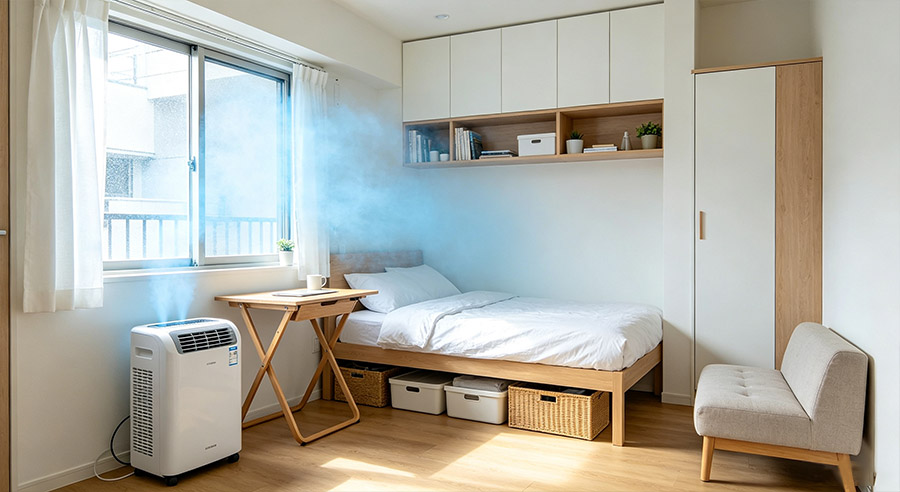
A good portable AC solves all these problems. It sits on the floor in a corner, uses a slim adjustable window kit that fits in the window track, and requires no screws or drilling. You can still open your window whenever you want, the kit is completely removable, and most landlords don’t object at all.
Portable AC vs. Central AC
If your apartment has central air, great—but it’s often expensive to run, and many older apartment buildings don’t have it. Portable ACs let you cool just your living space instead of paying to cool the entire apartment, which saves money.
What Size Portable AC Do You Need?
For small apartments:
- Studio up to 300 sq ft: 8,000–10,000 BTU
- 1-bedroom up to 500 sq ft: 12,000–14,000 BTU
It’s better to go slightly larger than too small. An underpowered unit will run constantly and never cool the space properly. Look for a compact, slim-profile model that doesn’t take up too much floor space.
Step 2: Perfect Your Installation
Even the best portable AC won’t work well if installed poorly. In a small apartment, proper installation makes an especially big difference.
Installation best practices:
- Use the included window kit properly. Extend it to fit your window exactly so there are no gaps. Premium no-screw kits slide into place and seal automatically.
- Keep the exhaust hose as short and straight as possible. Every extra bend reduces efficiency.
- Seal any small gaps with foam tape or weatherstripping. In a small space, even a tiny leak of hot outside air makes a big difference.
- Place the unit near the window, not on the opposite side of the room. Long exhaust hoses lose cooling power.
- Don’t block the air intake. Leave at least 12 inches of space around the sides and back of the unit.
Step 3: Block Solar Heat Before It Gets In
In a small apartment, windows are the #1 source of unwanted heat. One south or west-facing window can add 10+ degrees to your indoor temperature on a sunny afternoon.
Easy, renter-friendly solutions:
- Blackout thermal curtains: The most effective option. Install with tension rods so you don’t drill holes. Close them during the day on sunny sides.
- Reflective window film: Sticks directly to the glass, reflects sunlight, and is completely removable. Great if you still want natural light.
- Temporary blinds: Cheap, easy to install, and effective at blocking direct sun.
Blocking sunlight before it enters your apartment lets your AC run 20–30% less and keeps the space much more comfortable.
Step 4: Reduce Internal Heat Sources
In a small space, every heat source adds up. Your fridge, oven, computer, TV, and even your light bulbs are all pumping heat into the air—and your AC has to remove all of it.
Simple changes that make a big difference:
- Cook on the stovetop instead of the oven, or use a microwave, air fryer, or outdoor grill
- Run the dishwasher and laundry at night when it’s cooler
- Switch all light bulbs to LED (they produce 75% less heat)
- Turn off your TV, gaming console, and computer when you’re not using them
- Keep your fridge and freezer full—they run more efficiently that way
These small changes can lower your apartment’s temperature by 3–5 degrees on their own.
Step 5: Improve Air Circulation
Good air flow makes cool air feel cooler and prevents hot spots from forming. In an open studio apartment, strategic fan placement can eliminate the need to crank the AC as high.
Tips:
- Place a small fan near your AC outlet to blow cool air across the room
- Use a tower fan in the corner for general air movement
- If you have a ceiling fan, run it counterclockwise on medium speed
- At night, if it’s cooler outside, create cross-ventilation by opening two windows and using a fan to pull air through
Remember: fans cool people, not rooms. Turn them off when you leave to save energy.
Step 6: Optimize for Nighttime Sleep
Getting good sleep in a hot small apartment is one of the biggest summer struggles. Your bedroom (or sleeping nook in a studio) needs extra attention.
Best practices:
- Pre-cool your sleeping area 30 minutes before bed by turning the AC down a couple degrees
- Use the AC’s sleep mode at night—it raises the temperature gradually and runs quieter
- Place a small bedside fan aimed at your bed for extra cooling
- Use breathable cotton or linen bedding that doesn’t trap heat
- Avoid hot showers right before bed
For studio apartments where the AC is far from your bed, position a fan to blow cool air from the AC toward your sleeping area.
Step 7: Keep It Efficient to Avoid Bill Shock
Small apartments have less space to cool, but electricity bills can still get high if you run your AC nonstop. These tips keep costs under control:
- Set your thermostat to 78°F when you’re home. Every degree higher saves about 3% on cooling costs.
- Use the timer function to turn the AC off while you sleep and on before you wake up
- Clean the air filter every 2–3 weeks. A dirty filter wastes energy and reduces cooling.
- Close off any closets or small unused spaces so you’re not cooling empty area
- Use dehumidifier mode on mild but humid days. It uses less energy and still improves comfort.
Common Small Apartment Cooling Mistakes to Avoid
- Buying a unit that’s too small. It will run 24/7, never cool properly, and wear out fast.
- Ignoring window sealing. Gaps around the window kit let hot humid air pour in.
- Putting the AC in the wrong spot. Corners with blocked airflow kill efficiency.
- Trying to cool the whole apartment with one tiny fan. Fans don’t cool air—they only cool you.
- Leaving electronics and lights on all day. Every watt of electricity becomes heat in your apartment.
Final Tips for Studio Apartments
Studios are the hardest because your kitchen, living area, and bedroom are all one space. The key is to focus cooling where you spend the most time:
- Position your portable AC so it blows toward your couch and bed, not toward the kitchen
- Use curtains or room dividers to partially separate the kitchen area, so cooking heat doesn’t spread as much
- Keep the kitchen window cracked slightly while cooking to let heat escape
- Use a small personal fan at your desk instead of cooling the whole room extra cold just for work
Wrap-Up
Cooling a small apartment doesn’t require renovations, expensive upgrades, or landlord approval. A compact, high-quality portable air conditioner with a tool-free window kit is the foundation of a comfortable summer. Pair it with sun-blocking curtains, smart heat-reducing habits, and good air circulation, and you’ll enjoy cool, comfortable space all season long—without breaking your lease or your budget.

Related posts
There’s nothing worse than tossing and turning on a hot summer night, sticky with sweat, watching the clock tick later and later. Sleep quality plummets... Continue reading
When summer heat hits, the market is flooded with cooling products that all promise relief. Portable air conditioners, tower fans, evaporative coolers, window units—each one... Continue reading
Summer electricity bills have a way of shocking homeowners every year. As temperatures rise, our air conditioners run longer and work harder, and the costs... Continue reading
Rooms without windows are some of the hardest spaces to keep cool in summer. Whether it’s an interior bedroom, a basement office, a converted garage,... Continue reading
Summer temperatures keep climbing year after year, and staying cool at home is no longer a luxury—it’s a basic necessity for comfort, productivity, and even... Continue reading

Add comment